

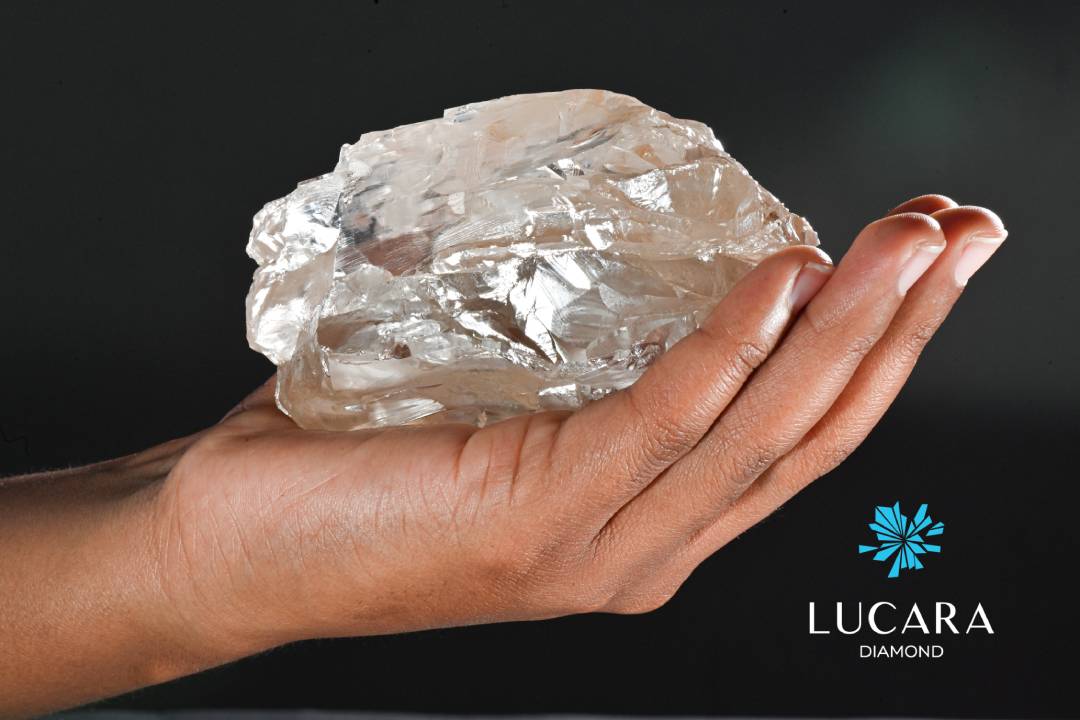
Once again, Botswana’s Karowe Diamond Mine has captured global attention after LucaraDiamond Corp. announced the recovery of an exceptional 1,305.4-carat rough diamond, making it the tenth diamond weighing more than 1,000 carats recovered from the mine since commercial production began nearly fourteen years ago.
The discovery comes just three months after Lucara announced two other remarkable recoveries from the same mine. Within only two weeks in April, the company unveiled two giant rough diamonds—one weighing more than 2,400 carats and another exceeding 1,000 carats.
The latest discovery is more than another headline in the mining industry. It marks a new milestone in the story of a mine that has become a remarkable phenomenon in the global diamond industry. The newly recovered stone is the tenth diamond weighing over 1,000 carats extracted from Karowe since commercial production began in 2012—an achievement unmatched by any other diamond mine operating during the same period.
The significance of this discovery extends far beyond the stone’s extraordinary size. It reflects a unique combination of geological fortune, advanced recovery technology, and Botswana’s long-term national strategy to transform its natural diamond resources into a source of global influence—moving .
beyond the export of rough stones toward value addition, branding, and the promotion of Botswana’s natural diamonds on the international stage
The Wonder Mine
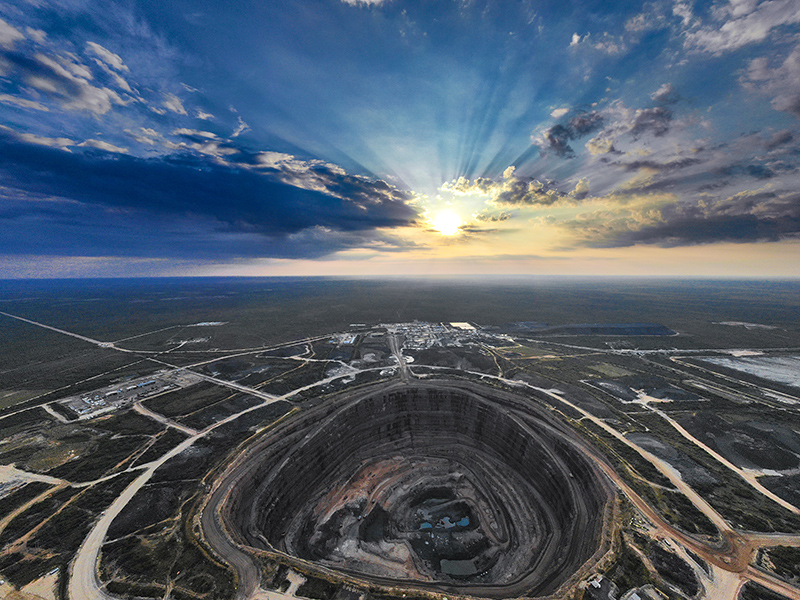
What sets Karowe apart is not the discovery of a single giant diamond, but the unprecedented consistency with which such discoveries have been made. Since commercial production began in 2012, the mine has recovered ten diamonds weighing more than 1,000 carats, making it the only diamond mine in the world to achieve this milestone during its operational lifetime.
Among the mine’s most celebrated discoveries are:
- Lesedi La Rona – 1,109 carats
- Sewelô – 1,758 carats
- Motswedi – 2,488 carats, the largest diamond discovered in more than a century
- And most recently, the newly recovered 1,305.4-carat rough diamond.
These discoveries are far more than a matter of geological luck. They have firmly established Karowe as one of the world’s premier sources of exceptional diamonds and one of the leading producers of Type IIa diamonds—the rarest, purest, and most valuable category of natural diamonds.
?Why Does Karowe Outperform Botswana’s Other Diamond Mines
Botswana is among the world’s leading diamond-producing nations and is home to several major mines, including Jwaneng, Orapa, and Letlhakane. Together, these operations produce millions of carats annually and form the backbone of the country’s diamond exports.
Karowe, however, has carved out a unique position—not through production volume, but through the exceptional quality and rarity of its diamonds. While Botswana’s larger mines are renowned for their scale, Karowe has earned international recognition for its remarkable ability to recover giant Type IIa diamonds, among the rarest and most highly prized natural diamonds in the world.
As a result, the Karowe name has become synonymous not with production figures, but with history-making discoveries. Every new recovery reinforces the mine’s reputation among the world’s leading sources of extraordinary diamonds and attracts the attention of international auction houses, prestigious jewellery maisons, and collectors of rare gemstones.
With each successive discovery, Karowe has evolved from a diamond mine into a global brand associated with exceptional stones, becoming one of Botswana’s strongest assets in promoting its natural diamond industry worldwide.
Natural Diamonds as Botswana’s National Identity: The “House of Botswana” Vision
The successive discoveries at Karowe are not merely geological achievements. They have come at a time when Botswana is reshaping its diamond sector strategy, seeking to move beyond its traditional role as a rough diamond exporter toward capturing greater value across the industry’s supply chain.
Although Karowe is operated by Lucara Diamond Corp., Botswana’s diamond success story began decades earlier with the establishment of Debswana, the joint venture between the Government of Botswana and De Beers. Debswana operates the country’s largest diamond mines, including Jwaneng, Orapa, and Letlhakane.
This partnership has long been regarded as a distinctive model among resource-producing nations. By maintaining direct government participation in the management of its natural resources, Botswana has been able to channel diamond revenues into education, healthcare, infrastructure, and long-term economic development.
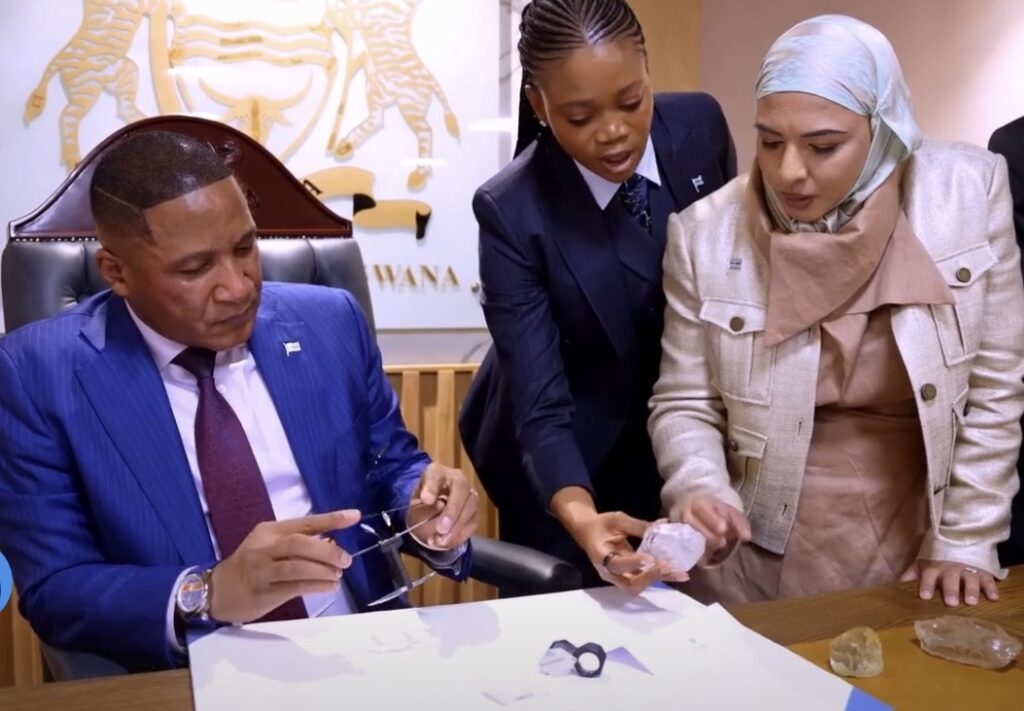
Under the country’s new administration, mining policy has entered a more ambitious phase. The strategy has gained additional momentum with the support of Minister of Minerals and Energy Bogolo Kenewendo, who has championed policies aimed at maximizing the economic value of Botswana’s diamonds rather than relying solely on the export of rough stones. The government’s objective is to strengthen Botswana’s position throughout the global diamond value chain by expanding local sorting, marketing, and manufacturing capabilities while promoting Botswana’s natural diamonds internationally.
Within this framework, Botswana launched the House of Botswana initiative, which goes beyond traditional marketing campaigns. The program presents Botswana diamonds as products with a clearly documented origin, built upon the principles of responsible mining, traceability, authenticity, and sustainability. The initiative also seeks to reinforce consumer confidence in natural diamonds at a time of growing competition from laboratory-grown diamonds.
This strategy reflects a broader shift in Botswana’s approach—from focusing primarily on production volumes to maximizing the value created from every diamond recovered. The country is positioning itself not only as one of the world’s leading diamond producers, but also as the owner of a trusted national brand associated with quality, transparency, and responsible sourcing.
Botswana’s promotional efforts extend well beyond trade exhibitions and commercial agreements. The country has increasingly incorporated diamonds into its national identity, even using locally mined diamonds in medals awarded at domestic sporting events. The message is clear: diamonds are no longer viewed simply as an export commodity, but as a symbol of Botswana itself and an integral part of its image on the global stage.
Technology Saved the Giant Diamonds from Being Broken
The mine’s remarkable success would not have been possible without advanced recovery technology designed to preserve exceptionally large diamonds. At Karowe, X-ray Transmission (XRT) technology plays a critical role in detecting and recovering valuable stones before they can be damaged during processing.
Recovering a giant diamond may appear to be a matter of geological luck, but modern mining tells a different story. Before the introduction of advanced sorting systems, many large diamond crystals were unintentionally broken during crushing because conventional mining equipment processed all rock in the same way, without identifying what might be hidden inside.
With advances in recovery technology, Karowe adopted the XRT system, which uses penetrating X-rays to scan ore before it reaches the final crushing stages.
Unlike conventional detection systems that rely on fluorescence or surface characteristics, XRT measures how different materials absorb X-rays. Because diamonds possess a unique atomic structure and density compared with surrounding rock, the system can identify a diamond concealed within the ore even when it is completely invisible to the naked eye.
The technology does more than simply detect the presence of a diamond. It generates a three-dimensional representation indicating the crystal’s approximate location, size, and orientation inside the host rock, allowing engineers to determine the safest recovery method before extraction begins.
Based on this information, the ore containing the giant crystal is diverted away from conventional crushing circuits and subjected to specialized low-impact processing. In some cases, the surrounding rock is removed gradually—or even manually—to preserve the diamond intact.
For this reason, modern recovery technology has become far more than a tool for discovering diamonds—it has become the key to preserving them. Industry experts believe that many of Karowe’s record-breaking diamonds, including stones exceeding 2,000 carats, would almost certainly have been broken into smaller pieces had they been processed using the conventional mining methods that were standard only two decades ago
From Extracting Rough Diamonds to Creating Value
Botswana no longer measures the success of its diamond industry by the number of carats recovered from the ground. Today, success is increasingly defined by how much economic value the country can retain within its own borders. After decades of exporting rough diamonds to international sorting, cutting, and trading centres, Botswana has adopted a strategy focused on capturing a larger share of the diamond value chain—creating jobs, developing local expertise, and increasing the economic return from every stone it produces.
As part of this strategy, the newly elected government renewed its long-standing agreement with De Beers. The new agreement represents more than an extension of a historic partnership; it reshapes the relationship by granting Botswana a greater role in managing and marketing its diamond production while strengthening the country’s ability to benefit from its natural resources.

While Debswana—the 50:50 joint venture between the Government of Botswana and De Beers—continues to operate the country’s largest diamond mines, the partnership has entered a new strategic phase. Botswana now also holds a 15% equity stake in De Beers Group, reinforcing its position not only as a production partner but also as a shareholder in one of the world’s leading diamond companies.
In recent years, an increasing share of diamond sorting, grading, and valuation activities has been relocated to Botswana after being concentrated abroad for decades. This shift has helped transfer technical expertise, create highly skilled employment opportunities, and strengthen Botswana’s position as a regional hub for the diamond trade.
The country’s evolving policy reflects a broader transformation—from simply collecting mining revenues to playing a more influential role throughout the diamond value chain. This includes expanding the role of Okavango Diamond Company in diamond sales while increasing domestic sorting, grading, manufacturing, and marketing activities, reducing dependence on traditional international sales channels.
Botswana’s strategy also extends to encouraging local cutting, polishing, jewellery manufacturing, and investment by international companies. Government incentives and training programmes are helping develop national expertise in diamond grading, polishing, jewellery design, and other specialized fields, laying the foundation for a fully integrated diamond industry capable of generating greater value from every diamond mined.
At the same time, Botswana has intensified its international marketing efforts by promoting its diamonds as products defined by quality, responsible sourcing, sustainability, and traceability. Initiatives such as House of Botswana are central to this vision. Rather than marketing diamonds simply as rough commodities, Botswana seeks to tell a complete story—from responsible mining practices to the confidence consumers can place in the origin and authenticity of every stone.

Recent developments—including Botswana’s renegotiated partnership with De Beers and its efforts to expand its role throughout the global diamond value chain—reflect a clear conviction: the true value of a diamond is not created when it is extracted from the ground, but through the processes of sorting, grading, manufacturing, marketing, and branding that follow.
With the continued success of mines such as Karowe, together with the country’s broader industry reforms, Botswana is positioning itself not merely as one of the world’s leading diamond producers, but as a nation seeking to play a greater role in shaping the future of the global natural diamond industry. Its ambitions are further underscored by its interest in increasing its stake in De Beers should additional shares become available, reinforcing a long-term strategy built on value creation rather than resource extraction alone.
Read more:
ممر جديد لتجارة الماس بين دبي وبوتسوانا لنقل الإنتاج الأفريقي إلى الأسواق العالمية
41.7 مليار دولار أمريكي قيمة 359.5 مليون قيراط حجم تجارة الماس في دبي خلال عام 2025
بوركينا فاسو: 6 مليارات دولار عائدات الذهب رسميا خلال النصف الأول من 2026