



The two men who entered Vienna’s MAK museum did not need an elaborate plan involving an underground tunnel, a cyberattack to disable the museum’s electronic systems, or even some spectacular break-in through a rear window.
All they needed were two admission tickets, a hammer, a weapon — and four minutes.
That was enough time to smash the reinforced glass, seize their target and flee.
They did not wait until visitors had left or the museum had closed. They entered during regular opening hours, posing as ordinary visitors, and disappeared almost as quickly as they had arrived.
They did not even bother with disguises.
They walked in with their faces uncovered and their steps assured.
41 Blows in Less Than Four Minutes
The two men headed directly towards their target. As one created an opening large enough to reach through the display case, the other brandished a weapon at those nearby, preventing anyone from intervening.
They did not simply grab as much jewellery as they could reach.
They took one necklace.
Among more than 300 rare and valuable creations by Van Cleef & Arpels presented in the exhibition, their target was Queen Nazli of Egypt’s diamond necklace.
The two men then fled, and news of the theft spread rapidly around the world. The missing necklace became a major story across the international jewellery community — not only because of its monetary value, but because of its historical significance and the striking ease with which this particular object had been taken.
What followed was one of Europe’s most compelling searches for a piece of historic jewellery in recent years.
Created by Van Cleef & Arpels in 1939, the necklace is set with 673 diamonds weighing more than 200 carats in total, with historical records putting the figure at approximately 217 carats.
Queen Nazli wore it at the wedding of her daughter, Princess Fawzia of Egypt, to the Crown Prince of Iran. Over the following eight decades, the necklace moved through history, private ownership and the auction market before eventually reaching the museum.
INTERPOL Moves After the Theft — But What About Its Recommendations Before It?
Within minutes, Queen Nazli’s necklace went from being a jewel displayed behind glass to the subject of an international search.
Its details were entered into INTERPOL’s Stolen Works of Art Database, Austrian police launched their investigation, and photographs and descriptions of the necklace became part of the tools being used to track it internationally.
The case quickly attracted attention across social media and among international organisations involved in combating crime.
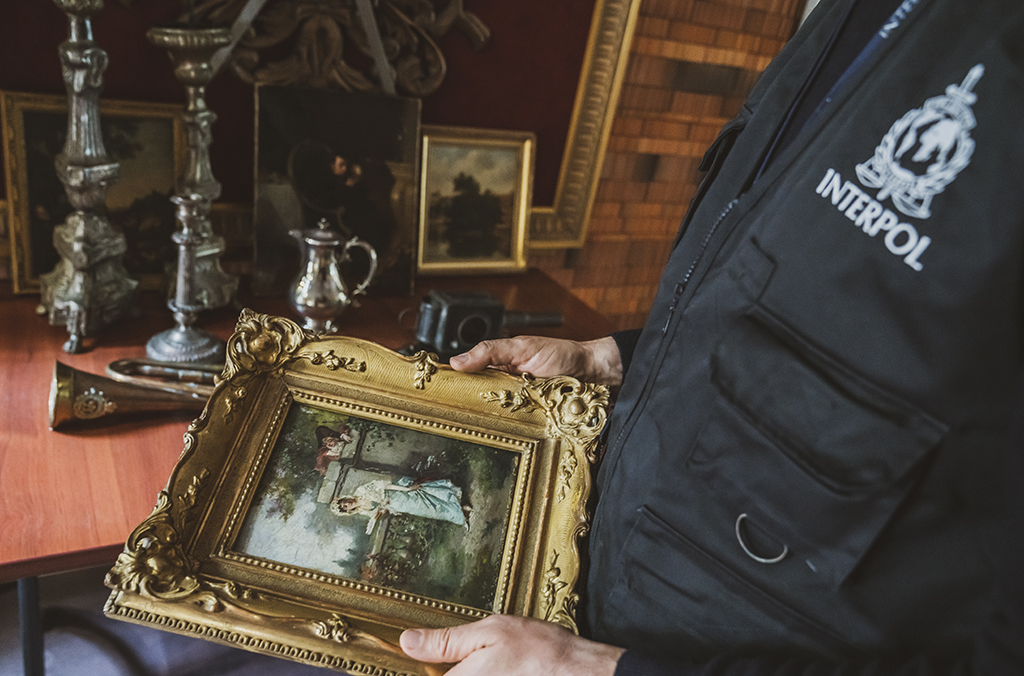
But it also raises a question that goes far beyond the fate of Queen Nazli’s necklace:
Why does the most intensive effort to track a jewel begin only after it disappears?
A 20% Clearance Rate — and Searches That Can Last Half a Century
Statements released on 1 September by the head of Austria’s cultural property crime unit at the Federal Criminal Police Office offered a revealing glimpse into the world of stolen cultural-property investigations.
Investigators examine auction catalogues, specialist dealers, online art platforms and INTERPOL and Europol databases, looking for photographs and identifying characteristics that might reveal the reappearance of a stolen object.
The unit also continues to rely heavily on specialist expertise and the human eye, which its head said remains slightly better than artificial intelligence tools for this particular work.
But another figure deserves attention.
The clearance rate for cultural-property theft cases in Austria is only around 20%.
Recovering a stolen object may take years or even decades. In one recent case, Austrian authorities recovered two statues 56 years after they had been stolen.
The delay does not necessarily reflect shortcomings in the investigation. The nature of the object itself can make an enormous difference.
A painting generally remains a painting.
A sculpture generally remains a sculpture.
A jewel, however, can disappear without its material ever disappearing.
INTERPOL’s Recommendations on Protection, Documentation, Identification and Recovery
Because cultural objects can be difficult to trace, INTERPOL provides recommendations intended both to help prevent theft and to make stolen objects easier to identify and recover.
Among its recommendations for owners and custodians of cultural property are:
- Establishing the provenance of an object before purchase.
- Checking objects against INTERPOL’s Stolen Works of Art Database.
- Maintaining an inventory containing photographs and accurate descriptions of each object.
- Refusing to purchase objects without adequate provenance documentation.
- Marking objects so that they can be easily identified, including through markings applied by owners or specialised private companies.
- Protecting the premises where collections are kept and immediately reporting thefts to law-enforcement authorities, accompanied by complete lists and photographs.
In other words, INTERPOL itself recognises the importance of making cultural objects identifiable.
Object ID
Other tools also contribute to documenting and identifying cultural property.
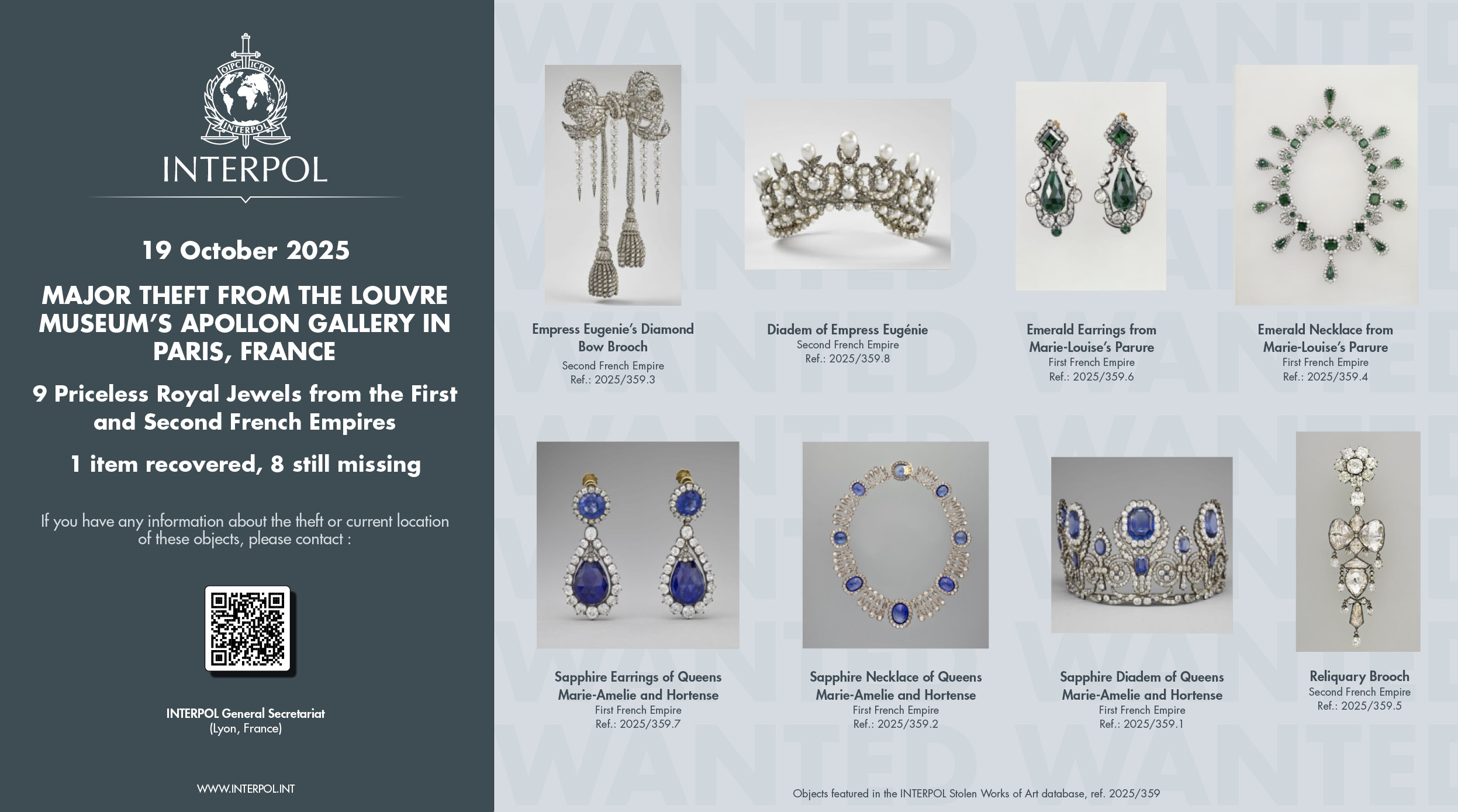
Object ID provides an international standard for describing cultural objects, helping authorities identify them if they are stolen.
INTERPOL’s ID-Art app allows museums and collectors to create records containing photographs and identifying characteristics that can assist law enforcement following a theft.
Its Stolen Works of Art Database contains photographs and descriptions of tens of thousands of objects and supports visual-image matching.
And this is precisely where the particular vulnerability of jewellery becomes apparent.
Object ID is highly useful when the object being sought still resembles the object that disappeared.
But Queen Nazli’s necklace could be reduced to hundreds of separate diamonds. Larger stones could potentially be recut and repolished, altering their weight, dimensions and appearance, while the platinum could simply be melted down.
What, then, would an image-matching system be looking for?
Jewellery may require an additional layer of identification beyond that used for a painting or stone sculpture.
Jewellery Can Disappear Forever Without Its Materials Disappearing
The easiest way to hide a jewel may be to make it cease to exist as a jewel.
A necklace can be dismantled, its stones removed and its precious metal melted.
Dozens or hundreds of gemstones could then be dispersed across different markets and countries. Larger diamonds could be recut, changing their dimensions, weight and identifying characteristics.
Eventually, every physical component of the jewel might still exist somewhere in the market while the jewel itself has disappeared forever.
Egypt witnessed an especially painful example in 2025, when an approximately 3,000-year-old gold bracelet belonging to Pharaoh Amenemope disappeared from a conservation laboratory at the Egyptian Museum and passed through intermediaries before being melted down.
The gold did not disappear.
The history did.
The Patiala Necklace: When Recovery Does Not Mean Restoration
The famous Patiala Necklace offers a different but equally revealing example.
Created by Cartier for Maharaja Bhupindar Singh in 1928 and set with nearly 3,000 diamonds, the necklace disappeared from the royal treasury under circumstances that have never been conclusively established.
Its enormous yellow De Beers diamond later surfaced separately at a Geneva auction in 1982.
Then, in 1998, Cartier discovered what remained of the necklace in London. Its principal stones were gone.
The jewel had returned.
But its memory had been scattered with its stones.
Its original appearance had been fundamentally altered, and replacement stones could restore its form but could not recreate the history carried by the originals.
The Jewellery Industry’s Traceability Paradox
This is where the theft of Queen Nazli’s necklace ceases to be merely a museum crime and becomes a broader question for the global gold, diamond, gemstone and jewellery industries.
Over the past two decades, companies, trade bodies and international organisations have invested enormous amounts of time, expertise and money in traceability.
The industry has attempted to follow raw materials through complex supply chains and answer increasingly detailed questions:
Where did the gold or diamond come from?
How was it extracted?
How was it transported and refined?
Who sold it?
Who bought it?
How was payment made?
Where did the money go?
These efforts have produced chain-of-custody systems, responsible-sourcing standards, blockchain platforms, laser inscriptions, nano-markers, DNA-based tracers, digital passports and other technologies designed to give raw materials a verifiable story.
The objectives are legitimate and important: preventing conflict financing and money laundering, reducing abuses and irresponsible mining practices, protecting consumers and safeguarding the reputation of the industry.
Yet years of work have also demonstrated how difficult raw-material traceability can be, particularly where artisanal and small-scale mining, numerous intermediaries, fragmented production and weak governance intersect.
Across significant parts of the world, gold and diamonds do not emerge exclusively from large industrial mines with controlled gates, central databases and a single documented system.
There are artisanal miners, small operations, local buyers, intermediaries, porous borders, smuggling, mixed production and multiple trading stages before material even reaches the point at which it can enter a formal traceability system.
Gold creates an additional challenge because it can be melted, mixed and refined repeatedly.
None of this is an argument for abandoning traceability.
It is an argument about priorities — and where expertise and technological effort are directed.
If the jewellery industry already possesses this knowledge and these technologies, why should more of them not be directed towards a category of objects whose starting point is often already known?
When a Jewel Becomes Worth More Than the Sum of Its Stones
A rough diamond has value when it emerges from the earth.
But it has not yet carried the idea of a designer.
A cutter has not spent hours shaping and polishing it.
A setter has not positioned it within a complex artistic composition.
Human hands have not spent tens or perhaps hundreds of hours transforming materials into a single work.
Then time adds another layer of value.
A queen wears it.
It appears at a royal wedding.
It accompanies a historical figure at a politically or socially significant moment.
It passes through generations, appears at an important auction and eventually enters a museum.
At that point, the jewel is no longer simply:
gold + platinum + diamonds.
It carries at least four layers of value:
material value, artistic value, historical value, and human and emotional value.
That accumulated value cannot simply be extracted again from another mine.
It may take decades — perhaps centuries — for one jewel among tens of thousands to acquire such significance.
So why do we invest so much effort in preserving the identity of a material at the beginning of its journey, only for our ability to follow that identity to become weaker once the object reaches its highest level of added value?
This question is not directed against any single institution, nor is it an argument for ending efforts against conflict diamonds or irresponsibly sourced gold.
It is an invitation to expand the philosophy of traceability itself.
If we are concerned that raw materials and their proceeds may be used for money laundering, conflict financing or other criminal purposes, the theft of historic jewellery presents another criminal risk — while simultaneously threatening artistic, historical and human value that may be impossible to replace.
Why Should Traceability End Once the Stone Becomes a Jewel?
The industry has developed tools, expertise and technologies over many years.
Perhaps it is time to apply some of them in another direction.
Instead of allowing traceability to end at the point of sale or the completion of the supply chain, why not begin a new stage for historic and exceptional jewellery — or even pieces whose owners regard them as irreplaceable personal heritage?
The purpose would no longer be simply to establish where the material came from.
It would be to ensure that the object does not lose its identity after becoming heritage.
Could a Jewel Carry an Identity That Helps Bring It Home?
A range of technologies has emerged for identifying and tracking diamonds, gold, goods and other valuable assets.
Potential avenues for further study include RFID, NFC, Bluetooth Low Energy, Ultra-Wideband, DNA and nano-markers, microscopic and laser inscriptions, 3D imaging, detailed gemmological characteristics, digital databases, sensors and increasingly small and lightweight smart tags.
Knouz News is not claiming that any single one of these technologies is ready to protect a century-old necklace or historic tiara.
Nor are we suggesting that museums simply attach commercial tracking stickers to heritage objects.
Conservation requirements, the physical properties of metals and gemstones, reversibility, power and connectivity requirements, signal range, and the possibility that a device might be detected and removed all require specialist evaluation.
Those questions belong to engineers, gemmologists, conservators and security experts.
But a simpler question can be asked now:
Could the industry develop a heritage-grade tracking tag — or an identification and tracking system designed specifically for historic jewellery?
And should recent thefts prompt us to examine whether some historic jewels displayed in museums have become easier targets than they should be?
This does not require placing a GPS transmitter inside a diamond.
A more realistic system could begin with the museum itself: a unique electronic identity for each object; readers inside galleries; sensors capable of detecting unauthorised movement; alerts when an object leaves its display case; and detection points along corridors and exits.
A layered security response could then isolate relevant areas or control movement routes while remaining fully compatible with fire, evacuation and visitor-safety requirements.
And, if technology permits, a device might continue transmitting for a limited period after leaving the building — perhaps minutes or hours during which law-enforcement officers could still follow the trail.
When a theft can be completed in less than four minutes, as in Vienna, the minutes immediately afterwards may be the most valuable in the entire recovery operation.
For exceptional jewellery, specialists could also investigate whether major gemstones should carry independent identities, so that if a piece is dismantled and one of its principal diamonds resurfaces years later, there is still a scientific or technological basis for comparing it with its previous identity.
Five Layers of Protection Instead of a Single Moment of Security
Knouz News therefore proposes opening an international discussion involving jewellery and precious-material organisations, museums, conservation specialists, gemmological laboratories, technology companies, insurers and security authorities.
The objective is not to select a particular device today, but to investigate a system that protects a historic jewel across five stages:
Before display: Build the most detailed possible digital, gemmological and physical identity for the object.
During display: Make movement of the jewel itself part of the security system rather than relying solely on the integrity of the showcase.
At the moment of attack: Trigger an immediate response identifying the object, its location and direction of movement while linking the event to cameras and security systems.
Before exit: Create a final electronic perimeter capable of registering the object’s passage or generating an independent alert, subject to all necessary safety and evacuation requirements.
After exit: Make the complete identity file immediately available to police and, where the crime crosses borders, to INTERPOL and international law-enforcement networks.
The roles remain distinct but complementary.
Industry and technology can develop identity systems and standards.
Museums can implement appropriate protection while safeguarding both objects and visitors.
Police respond to the crime.
INTERPOL supports international tracing and recovery when a case crosses borders.
Who Insures History?
It was natural for MAK to tighten security following the theft of Queen Nazli’s necklace.
More guards, more cameras, stronger display cases and metal detectors all strengthen protection of the premises.
But perhaps the next stage requires an additional objective:
protecting the jewel itself from disappearing.
A thief may break the glass.
He may evade a guard.
He may leave the camera’s field of view and exit the building within seconds.
But what if the object he carries could, for at least a short period, tell the security system:
I am here. You can still find me.
And if the thieves manage to silence that signal and dismantle the jewel, what if its principal stones retain identities capable of revealing what they once belonged to?
For years, the gold and diamond industries have tried to answer one question:
Where did this stone come from?
Queen Nazli’s stolen necklace presents another question worthy of the same degree of innovation:
After everything human beings have added to the stone, how do we make sure we do not lose it?
September: Put the Question on the Industry’s Agenda
September brings together some of the most important gatherings in the international jewellery, gemstone and precious-metals calendar — from CIBJO’s Centenary Congress, Vicenzaoro and the T.GOLD technology exhibition in Italy to Jewellery & Gem WORLD in Hong Kong.
For a few weeks, decision-makers, professional organisations, gemmological laboratories, manufacturers, traders and technology developers will be gathered around the same industry.
The theft of Queen Nazli’s necklace offers an opportunity to put a new question on their agenda:
How do we protect a jewel after we have created it?
Knouz News is not calling for less attention to raw gold and diamond traceability, illegal mining, conflict financing or money laundering.
We are calling for some of the industry’s research capacity, expertise and technological effort to be directed towards the other end of the value chain — towards objects whose makers, histories and components are often already known, and whose material value has been multiplied by artistic, historical and human significance.
The Responsible Jewellery Council should consider the fate of jewellery after manufacture alongside its work on responsible practices across the supply chain.
CIBJO, the World Jewellery Confederation, should bring the protection of historic jewellery into the wider conversation about the future of the industry, alongside sustainability, responsible sourcing and the rights of those working throughout the supply chain.
No one needs to decide today whether the answer is RFID, BLE, UWB, DNA, laser inscription or something that has not yet been invented.
The first step is to put the question itself on the agenda.
Jewellers, gemmological laboratories, museums, technology developers, conservators, insurers and security experts should examine whether an international standard can be developed that begins approximately where today’s traceability systems tend to end:
after the stone becomes a jewel — and the jewel becomes history.
Egypt: When the Stolen Jewel Is Part of Its History
Egypt should not stand outside this discussion.
Not simply because it possesses one of the world’s richest cultural heritages, but because the jewel now being pursued internationally was once the necklace of an Egyptian queen and was associated with a significant event in modern Egyptian history.
Queen Nazli’s necklace was not owned by the Egyptian state when it was stolen. It had passed through private ownership and the auction market before being reacquired by the maison that created it and displayed in Vienna.
But ownership of an object is one thing; its place in historical memory is another.
The necklace was created for Queen Nazli and became inseparable from her image and from the 1939 wedding of her daughter, Princess Fawzia, to the Crown Prince of Iran.
Its disappearance therefore represents more than a loss to a private owner or a European museum. It threatens the survival of a material witness to a chapter of modern Egyptian history.
For Egypt, this is not a theoretical concern.
In September 2025, an approximately 3,000-year-old gold bracelet belonging to Pharaoh Amenemope was stolen from the Egyptian Museum and ultimately melted down.
Egypt did not merely lose a quantity of gold.
It lost an artefact that no amount of money could reproduce.
Egypt also continues to confront the long legacy of antiquities that left the country under widely differing historical circumstances, while authorities continue efforts to recover objects that were illegally trafficked or stolen. Archaeological sites, storage facilities and museums have also suffered theft and looting during periods of security breakdown.
Against that background, Knouz News finds it striking that, so far, there has been no publicly visible Egyptian response proportionate to the historical and symbolic significance of the theft of Queen Nazli’s necklace.
That does not mean that no contacts or actions have taken place behind the scenes, nor does it imply an Egyptian ownership claim where none exists.
It is a question of showing concern for history that belongs to Egypt’s story.
The case should also encourage a wider effort to document and trace historic Egyptian jewellery held by museums, jewellery houses and collections around the world; to examine lawful avenues for recovering objects to which Egypt has a legitimate claim; and, where exceptional pieces legally enter the market, to consider acquisition or repurchase.
It may also be time to examine the case for a specialised Egyptian museum dedicated to the country’s history of gold and jewellery.
Egyptian authorities responsible for museums, antiquities and heritage security — together with jewellery organisations, conservators, insurers and technology specialists — should participate in this international conversation not merely as recipients of technology developed elsewhere, but as representatives of a country with a direct interest in shaping, testing and setting standards for it.
A country still searching for objects that disappeared years or decades ago — and which lost a 3,000-year-old bracelet to a melting pot only last year — has every reason to ask:
Can technology help us prevent the next historic object from disappearing before we are forced to spend years searching for it?
Queen Nazli’s necklace may no longer belong to Egypt in the legal sense.
But history is not defined by a certificate of ownership alone.
A person may own a jewel. A museum in another country may display it. The maison that created it eight decades ago may acquire it again.
But the story embedded in that jewel does not transfer in full with a sales invoice.
Queen Nazli’s necklace was privately owned when it was stolen. But it was — and remains — part of Egypt’s history.
READ MORE:
سرقة قلادة الملكة نازلي من متحف بفيينا.. مرصعة بـ 673 ماسة بإجمالي 204 قراريط
الأميرة فوزية فاروق تأسف لسرقة عقد الملكة نازلي: جزء لا يُعوّض من تراث مصر- عمره 87 عاما.
تاج النهضة المصرية المجهول يحقق 88,595 دولارًا في مزاد Elmwood’s بلندن